The way people buy has fundamentally changed. Customers today research longer, compare more, and trust less. They follow creators, read reviews, scan Google ratings, and evaluate every option before they ever decide to buy or book anything.
But most websites?
They’re still built like it’s 2018 — pretty, shallow, and missing the critical elements modern buyers depend on.
That’s why FlowCommerce created the 2026 Website Framework a strategic, conversion-driven system engineered around how people actually make decisions today. It is outcome-driven, research-backed, and trust-maximized by design.
And starting now, it’s the default system behind every website FlowCommerce builds.
Let’s break down what makes the 2026 Website Framework the new gold standard.
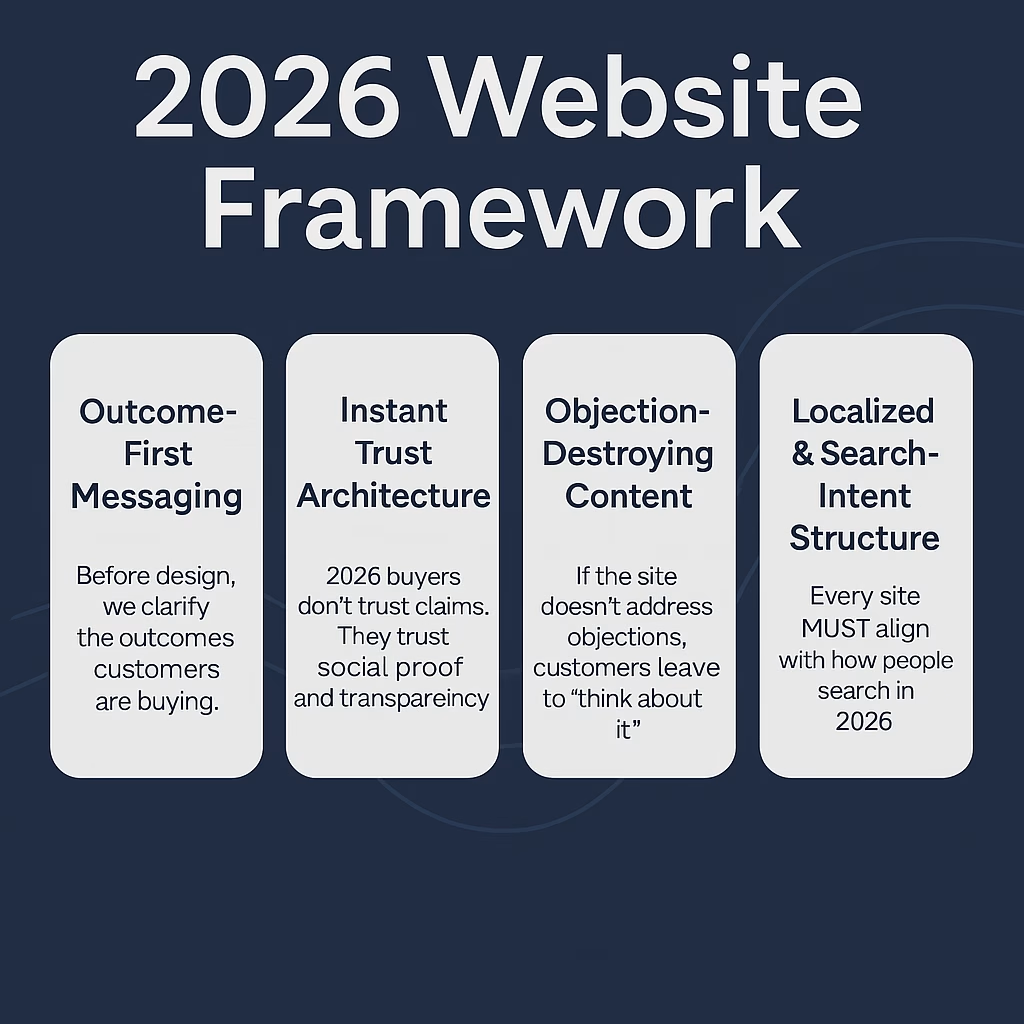
1. Outcome-First Messagingrr
Before design, branding, or features, we clarify the outcome the customer is buying.
Modern buyers don’t care about what a product is.
They care about what it changes.
That’s why the 2026 Website Framework starts with questions like:
What transformation will the customer experience?
What frustration disappears?
What benefit becomes possible?
When your hero section leads with outcomes instead of features, conversion instantly increases — because buyers see themselves in the story.
2. Instant Trust Architecture
In 2026, claims don’t convert — proof does.
Buyers now trust:
Reviews
Photos
Google Business Profiles
Testimonials
Social proof
Transparent explanations
So every FlowCommerce site includes trust signals intentionally and early.
This means:
Reviews above the fold
Real customer photos
“As seen on” logos
Before & after sections
Verified ratings
Clear process, clear expectations
Trust isn’t optional anymore — it’s the cost of entry.
3. Objection-Destroying Content
If your website doesn’t answer the questions in a buyer’s head, they leave to “think about it.”
In digital behavior terms?
“Thinking about it” means they’re gone forever.
The 2026 Website Framework bakes objection-handling directly into content structure:
Why is this worth the price?
How does this compare to alternatives?
How long will it take?
What if it doesn’t work for me?
What’s the real result?
Address objections early → conversions climb.
4. Frictionless Conversion Path
The path from interest to purchase (or booking) must be brain-dead simple.
FlowCommerce sites include:
One clean primary CTA
Predictable structure
Zero dead ends
Scannable layouts
Clear mobile pathways
Buttons that say what happens next
If the customer doesn’t know what to do next in three seconds, the site failed.
5. Localized & Search-Intent Structure
Search behavior has evolved and content needs to match it.
The 2026 Website Framework includes:
Service-based localized landing pages
City and neighborhood SEO pages
Google Business Profile optimization
Search-intent mapping (“near me,” service keywords, symptoms, goals)
Local schema markup
This structure ensures websites rank where buyers are searching, not just where keywords look good.
6. Content That Sells the Story Before the Sale
Content now creates the conversion.
Story-driven websites consistently outperform feature-driven ones. That’s why our framework includes:
Founder story
Why the business exists
What makes the brand different
What results look like
Proof embedded throughout
The site becomes a narrative — not a brochure.
7. Transparent Process + Pricing Clarity
Uncertainty kills conversions.
When buyers don’t understand how a service works or what it costs, they hesitate. Hesitation = lost revenue.
The 2026 Website Framework includes:
Easy “How It Works” visuals
Timelines
Price anchors or ranges
Step-by-step expectations
Clarity creates confidence.
8. Brand Story → Points of Difference
If your website doesn’t communicate what makes you the choice, buyers default to the cheapest competitor.
Using this framework, every FlowCommerce site clearly highlights:
Unique strengths
Experience
Philosophy
Distinct advantages
Results and outcomes
When difference is obvious, choosing becomes easy.
9. Measurement, Analytics, and Optimization Setup
A modern website isn’t complete without performance tracking.
Each site provides:
GA4 setup
Custom events (clicks, calls, bookings, carts)
Conversion funnels
Heatmaps (scroll, click)
Lead routing
CRM integrations
SEO & page performance monitoring
If you can’t measure it, you can’t grow it.
Why This Framework Matters in 2026 and Beyond
This system is not a “nice to have.”
It’s the new minimum standard for websites competing in a trust-first, research-heavy digital world.
It’s also the foundation FlowCommerce uses to deliver:
Higher conversion rates
Lower customer acquisition costs
Clearer messaging
Stronger SEO performance
Better lead quality
Faster paths to revenue
This is how we build websites that work, not just websites that look good.
Final Thoughts
The FlowCommerce 2026 Website Framework is built for founders, service providers, and brands who need more than a pretty website — they need a digital machine designed to convert.
This framework shapes every decision, every design choice, and every line of copy.
And it ensures every client gets a modern, high-performing site grounded in strategy, clarity, and trust.
If you’re ready for a website built for how people actually buy today — we’d love to help. Let’s chat and run a free SEO localized audit report.
Author
Sean Wolf
With over 16 years of eCommerce leadership, I specialize in architecting and scaling Direct-to-Consumer brands across both established and emerging markets. Most recently at Johnson & Johnson’s Kenvue division, I spearheaded the end-to-end launch of a startup women’s health platform targeting the menopause segment—driving a seamless omnichannel experience through enhanced UX/UI, strategic 3PL partnerships, and the successful rollout of Salesforce Marketing Cloud to automate and optimize the full CRM lifecycle. These initiatives not only elevated customer engagement and on-time delivery metrics but also delivered double-digit improvements in conversion rates and customer retention.